
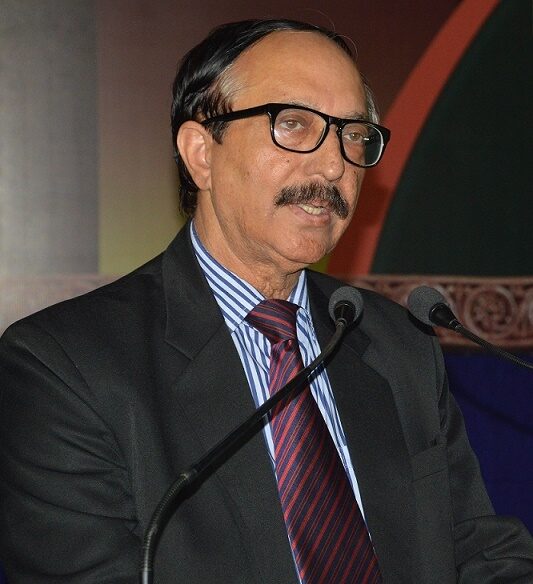
An overview by our founder
This essay is drawn from Dr. H. K. Kaul’s overview of the Society.
Indian poetry has flourished over the last 4,000 years. Today, it is composed and written in more than twenty Indian languages, including English. It has always echoed the voice of the times and revealed the pains and passions of the people. Its growth has also reflected our rich cultural heritage.
The history of Indian poetry makes us aware of its glorious past in contrast to its present state. Today, as the world is shrinking and the communication network is projecting man on the global scene much faster, the past values are getting lost in the struggle man is involved with. Issues confronting man have multiplied and so have his efforts for survival. Poetry today is facing the test of time.
Poets need to be organised more vigorously than in the past to voice effectively their innermost thoughts and interact with each other more often. Giving away of awards to some of the few distinguished ones is not enough. Poets in India need to be encouraged in their creativity if we expect their contributions to transform our society. New life is to be given to old values which had stood us in good stead for so long. The poets should come to the forefront to undertake this job.
Organised efforts need to be made to promote the production and publication of good Indian poetry. Poetry written in different parts of India needs to be collected, interpreted and propagated.
The problem we set out to solve
We have no figures of the very many poetry lovers among our masses. Though some of them still attend readings, mushairas or kavita sammelans, the unprecedented growth of film songs and their regular broadcasts and telecasts have rendered the populace less attracted to good poetry. This effect ought to be counteracted by encouraging the reading and appreciation of good poetry, or by listening to it in suitable environments.
Poets and poetry-lovers are also divided into segments by several factors. Different linguistic and regional divisions, and the language policies adopted by our State Governments, have brought about this state of affairs. No single language can grow uniformly throughout the country in the present circumstances.
Poets are an indigent lot. After spending much time and energy composing their verses, if a collection is published at all, they hardly gain financially. As Indian poets are not organised, they are hardly able to communicate with their readers or receive the feedback they need. Writing poetry may not be a wholly professional activity, as no poet lives on the earnings from his poetry, but it is certainly a serious vocation of the most sensitive. The writing of poetry is not a mere pastime.
The distribution of anthologies creates great problems for poets and publishers. Readers do not know what is being published elsewhere in the country, and if they do know about a title, they find it difficult to obtain unless they are favourably located. As poetry is priced low, distributors do not find it profitable. Publishing poetry has therefore remained a non-commercial activity in India: publishers do it as an act of charity to oblige the poet, or to maintain a growing list of new titles.
Founding the Society
Some steps, therefore, needed to be taken to bring poets together. In the early 1980s Dr. Kaul organised several meetings of poets in Delhi to discuss these problems and to create a forum devoted exclusively to the promotion of poetry in India. Many poets agreed with him and some disagreed. Nevertheless, The Poetry Society (India) was established in July 1984.
Besides H. K. Kaul, its founder members were Keshav Malik, Dr. J. P. Das, Dr. Lakshmi Kannan, Man Mohan Singh, Sunita Jain, S. Balu Rao and Priya Devi.
Our aims
The Society was launched to:
- promote Indian poetry and look after the interests of poets in India;
- undertake collection, interpretation, translation, publication and propagation of Indian poetry in India and other countries;
- arrange expert advice on composition, publishing, distribution and translation of Indian poetry;
- help maintain the highest standards and foster a sense of literary affinity among poets writing in different languages in India;
- undertake, facilitate and provide for the publication of newsletters, and of a journal devoted to Indian poetry;
- assist in the settlement of differences and disputes between members of the Society on the one hand and other bodies and individuals on the other;
- award grants, fellowships, prizes, subventions and assistance to poets and translators of poetry; and
- engage in such educational, literary and charitable activities as would promote the objectives of the Society.
The full objects are set out in our Memorandum of Association.
Readings, seminars and visiting poets
Over the years TPS has organised seminars, readings, workshops, lectures, festivals, symposiums, competitions, and the publication and release of poetry anthologies. Workshops conducted by Henry Taylor, Prof. Nissim Ezekiel, Dr. Tom Paulin and Brian Patten were found especially useful by poets in the early years, and many well-known poets have led workshops since.
Among the foreign poets invited to read were Shirley Kaufman (USA), Alexander Mezhirov and Olzhas Suleimenov (USSR), Prof. Edwin Thumboo (Singapore), Les Murray (Australia), Tom Paulin (Britain), Barbara Lefcowitz (USA), Sigurdur A. Magnusson (Iceland), Christopher Levenson (Canada), Tulasi Diwasa (Nepal), Madison Morrison (USA) and Alan Brownjohn (UK). Ms. Carol Bruce, a specialist in the art of reading poems, explored the labyrinth of love from Confucius to e. e. cummings. Christopher Moony, an Australian poet, sang his ghazals in English.
The Society has also held poetry evenings in honour of Dylan Thomas, Gerard Manley Hopkins and Dinanath Nadim.
The Society today
The Poetry Society admits Life Members, Associate Life Members and Members who remain associated with its activities. TPS continues to organise programmes from time to time, and poetry lovers and poets are welcome to help and take part.
The Poetry Society (India) will continue promoting and propagating poetry through its programmes and publications, with its limited financial resources and unlimited goodwill.